Nothing Can Stop Me, I’m All the Way Up
Cusco stands at an altitude of 10,000 feet. I felt the change in altitude the minute I hit the jetway upon my arrival from Lima. The air was thin and cold and I realized immediately that I needed to slow my pace as I wound my way through the airport to the taxi stand outside. My girlfriends, who were doing the Inka Trail with me, had arrived in Cusco a day ahead of me and were kind enough to send this charming gentleman to stand outside and greet me.

He took me straight to our Airbnb in the mountains above downtown Cusco. Think of Cusco as the largest football stadium you’ve ever seen and then imagine sitting in the uppermost seat in that stadium and you have found our Airbnb! The views from there were spectacular.

The ladies had had a leisurely afternoon exploring the cobbled stone streets of Cusco. They were excited to let me know that they had made a group decision for all of us to go on a spectacular tour of hot springs and blue lagoons the following day. We would be hiking and horseback riding to the hot springs. Our tour guide told us we were to have no alcohol, no meat, and no dairy, or we would suffer tomorrow. So, off we headed to dinner and enjoyed a warm bowl of chicken soup.
We climbed into bed early for we had a 3 am wake-up call the next day. What the heck? Yes, we were to drive for 3 hours to the point where we would ride horses and then hike to our final destination, the five blue lagoons.
Our 8-seater van was at-the-ready at 3 am and we each had a row of seats to ourselves to stretch out and try to catch 3 hours of sleep while we drove. It was pitch black outside and easy to fall asleep. We awoke with the sun at 6 am and our driver pulled over to a roadside mercado (market) where he bought us a typical Peruvian breakfast of quinoa seeped in hot apple juice that we sucked through a straw.

Although I would not voluntarily eat it again, it wasn’t all that bad. We topped that off with a typical Peruvian breakfast sandwich of light bread and a thin piece of cheese.

We ate in the van as we drove for another hour to our destination.
The terrain we passed through was rugged and cold. Vegetation was sparse. Rock walls, llamas, and oddly, Peruvian women, not men, were all that we saw on the roads.


Peruvian women are spectacular! Their attire consists of flat shoes, woolen tights covered in leg warmers, large puffy skirts, and layers of colorful sweaters. Most women carry colorful packs on their backs that are filled with either their handiwork or their babies. I do not know why there were little to no men on the roads at 6:30 am. It was definitely ladies’ hour.


Our tour bus stopped in front of a grouping of 3-5 white stucco homes that were peppered across the sparse terrain. We were told to grab our gear and exit the bus. It was chilly outside and I noticed immediately that my head was throbbing. I could hear the sound of my heartbeat in my ears. No one else in the group seemed to be bothered as I was so I figured it would pass and moved on as best I could.
We followed our guide into one of the white stucco buildings where he opened a bag of what looked like bay leaves and told us to take a handful of the leaves and tear them up, then put them into our mouths and chew on them until they were soft enough to tuck into our upper or lower lip where we would keep them all day long. These were coca leaves. These leaves are supposed to help with altitude sickness.
I did as I was told with the hope that my headache would subside. I even poured hot water over the leaves while we waited for our horses to arrive and heartily drank the tea.

The taste was bitter and unpleasant but not as unpleasant as the unending pain in my head.

After we drank our tea we climbed aboard our horses. Our Peruvian guides began our quest to the azure lakes beneath the glacier that loomed in front of us.

The path to the glacier was rocky and the air was brisk. All but one of us had horseback riding experience so moved along well, cheering on our compadre who was a bit nervous on her trusted steed but gained confidence as we rode forward.

Our path took us alongside glacial rivers and houses made of mud and weed bricks. The homes had thatched roofs and no electricity. We passed wild llamas roaming the rocky hills and were treated to a rare sighting of an animal that looks like a cross between a rabbit and a squirrel.

We rode for almost an hour until we reached the first of five lakes on our tour and were told to dismount. I slid inelegantly off my horse and the minute my feet hit the ground I felt as if my head was going to split open. I was sure I was going to vomit. Our guide came toward me with a plastic bag filled with coca leaves and told each of us to chew the leaves immediately to help with the altitude. The thought of sticking those god-forsaken leaves in my mouth again made me sick just thinking of it.
My nausea was still front and center as we began our hike. Each step I took made my head pound but I kept moving and kept taking deep breaths, trying to get air into my lungs. I was gasping for air every 2-3 seconds, breathing heavily through my mouth. My nostrils were frozen by the cold, dry climate and were simply not getting me the air I needed. I had to repeatedly stop every three to five feet to breathe deeply until I felt I had enough air in my lungs. We hiked forward for what felt like a mile until we reached our second azure lake.

It was next to this lake that I saw a sign and walked over to read what it said. It was at the moment of reading that I realized why I was suffering so badly. We were at an altitude of almost 15,000 feet!

I had only been at 10,000 feet for 8 hours since I arrived in Cusco and was now hiking and horseback riding at nearly 15000! No wonder I was so sick! Why hadn’t anyone told us?! Better yet, why hadn’t we asked when we booked the tour how high we would be going?! All I can tell you is do NOT do what I did, please do what I say: Always, always ask how high your tour is going to be when you are in Peru and always prepare yourself for the attitude by acclimating for days, not for hours, before you trek.
We stayed at the lake taking photos, pretending to smile and act as if everything was fine. We got some spectacular photos at each lake we hiked to.

At the third lake, our Peruvian guide pulled out a flute and harmonica and treated us to an impromptu concert at the water’s edge.


In Peru, music and art are an integral part of life and each village has its own distinct style of music and handiwork. When Peruvians come together they share their art and applaud each other’s unique style. Peruvians can tell where one comes from by the music they play and the colors they use in their beadwork and weaving.
The weather had turned on us during our trek and it began to hail as we reached the fourth lake.
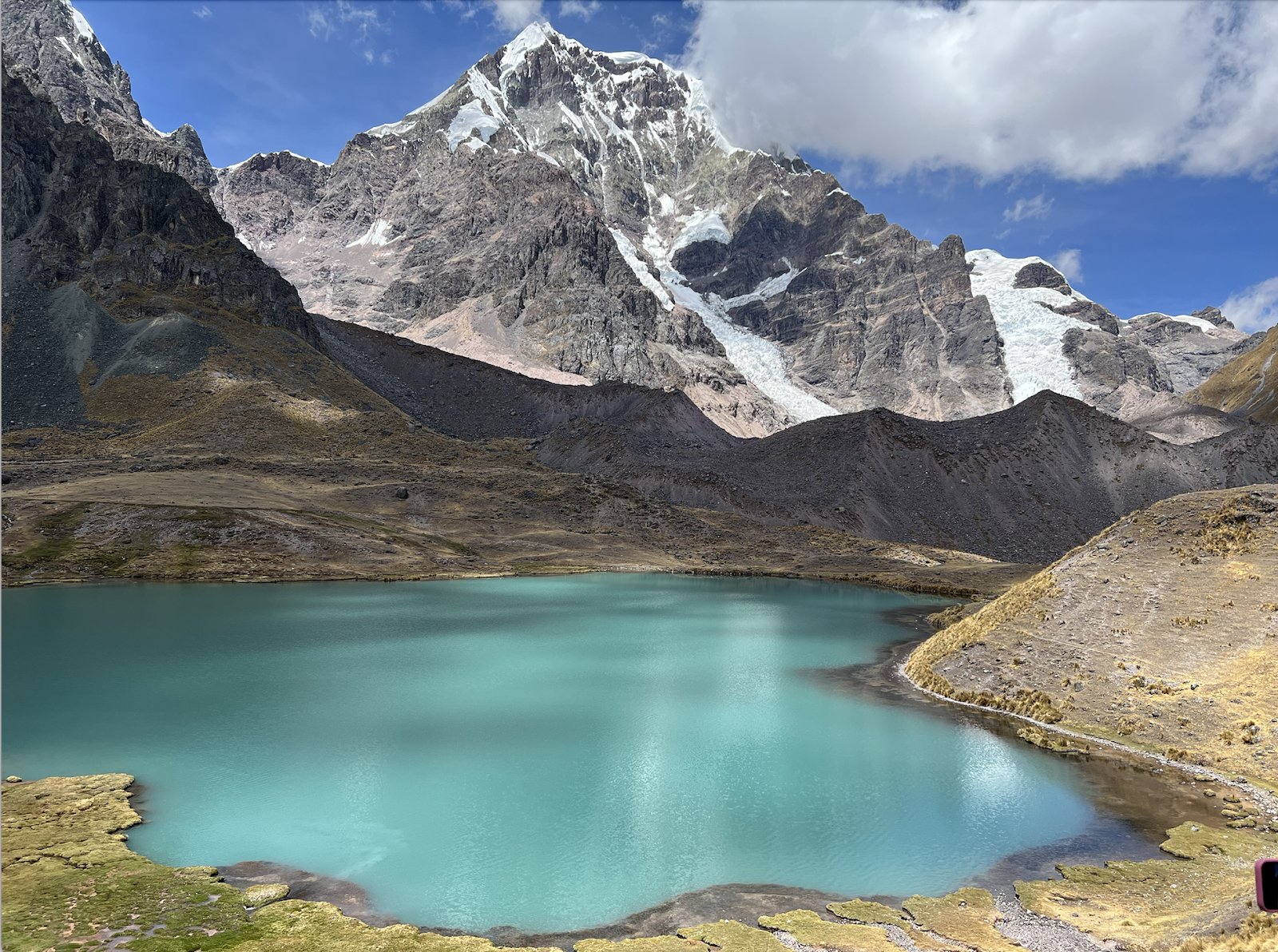
It was at the last lake that one of my trek-mates (Cora) admitted to the group that she was in bad shape and was going to throw up. I chimed in that I, too, was going to vomit. Our guide told us to get moving, and that we needed to get back to a lower elevation quickly. We asked if we could just please sit still for a minute to rest but he said no, no matter how bad we hurt, resting would not help, we had to get down to a lower elevation. And, just as we put our feet back on the path it started to hail.
It hailed upon us the entire horse ride back to our van. Both Cora and I were so sick that we rode the horses for an hour with our eyes closed, opening them only when the local Peruvian women along the route would shout out to us to buy their wares. It was amazing to see these hardy women come out of their thatched homes with large bags on their backs, running towards us to set up their “market” at the feet of our horses. It would have been rude not to buy what they had made because god knows how often anyone ever comes by this route.


This woman above lives alone in a stone house with no electricity and, judging by her eyes, I believe she may be blind but still, she sat there, by the horse path to sell her wares to strangers who passed by her in this desolate landscape.
Needless to say, the three-hour drive back to Cusco was horrendous. The roads were unpaved and each jolt over rocks and into ditches made me feel as if my brain were going to crack out of my skull. Poor Cora hung her head out the window to find reprieve from her altitude sickness but to no avail.
We got back to our AirBnb and tenderly laid our heads upon our pillows, grateful for the sights we had seen and the lesson we had learned that you do NOT travel to 15,000 feet on your first day in Cusco. I fell asleep deeply concerned for my future because I knew that on Day 2 of my upcoming trek to Macchu Picchu I was to hike for 11 hours and ascend to 14,000 feet. I realized then that something can stop me when I’m “all the way up”. Gulp.
Wow, these pictures and your writing paint a vivid picture of your adventures! I love reading it but can’t imagine voluntarily doing it!