
The One Percent Club
Seven thousand people visit Machu Picchu daily. 70 of those 7,000 people (1%) arrive at Macchu Picchu via the Inca Trail. The remainder arrives via bus and train. When my girlfriend, Jennifer Solomon, called and asked me to celebrate her 50th birthday by climbing Machu Picchu with her I did not hesitate for one second and screamed “Hell yes!” into the phone. And that was it. It was happening.
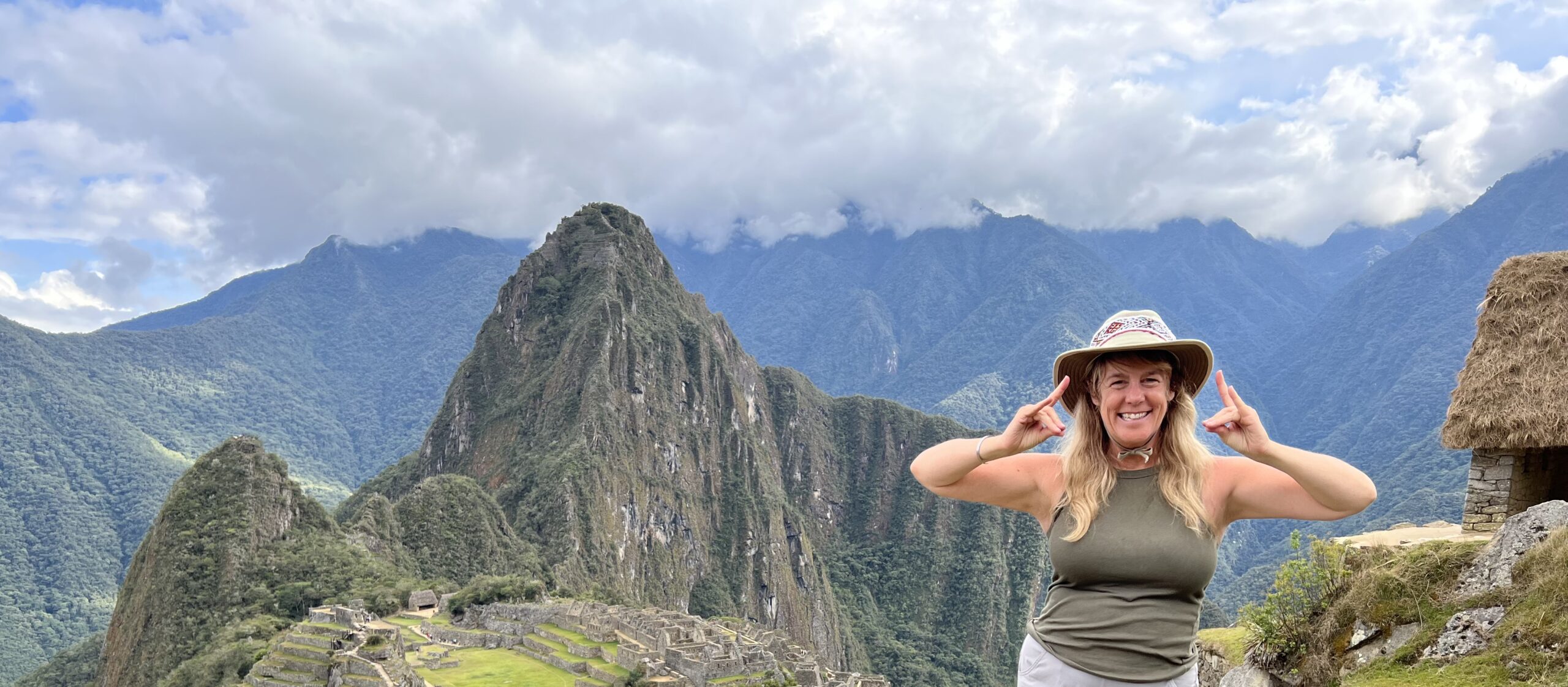
Jenn is an incredible planner and did all the research for the trip. She chose Alpaca Tours as our tour group because they were Incan-owned and operated and had strong social mores. They were green, sustainable, educational, and affordable. Our 4-day, 3-night trek on the Inka Trail was all-inclusive and cost only $600.00 (US$) The link to this incredible operation can be found here: https://www.alpacaexpeditions.com/inca-trail-treks/
I trained for the trek for five months. I was fortunate to hire a personal trainer (Daulton Stoltz) and the two of us worked 3x per week on building strength in my posterior chain (bottom half of my body) as well as worked on building up my upper back and shoulders to enable me to carry my pack with ease. When I was not strength training with Daulton, I had a 25 lb weight vest on my body and was logging hours on the Stairmaster and treadmill to prepare for the upcoming trek.
On October 2nd, 2022 Jennifer Solomon and her two friends; Cora and Kathy, and I, carried our packs down to the street in Cusco, in the dark, at 3:30 am, to meet our driver to begin our Inka Trail Trek.

We had attended an orientation meeting at the Alpaca Tour offices (in the main square in Cusco) the night before our departure and were given green duffle bags to pack our clothes. Our porter would carry the green duffle bag for us for the next 4 days and its contents could weigh no more than 8 lbs. The porter would also carry our sleeping bags and air mattress on his back.
I carried my own day pack that contained changes of clothes for the different microclimates we were to face each day, toiletries, snacks, and water.

Our bus drove through the dark city streets and picked up the other folks who were joining us on our trek. We were 13 strong. We rode the bus in silent darkness, not speaking until we stopped at “The Porters’ House” at Ollantaytambo where we had our first meal together and met our porters.

We were joined by two couples from PA that live to hike, 2 girls in their 20s from Argentina, a single woman from NYC that is an endocrinologist, a single man from Utah coming to us fresh from an Ahuyasca experience, and a single girl from Oregon who works in hospice. Breakfast was bountiful but, as usual, we were told to eat little to nothing so that we did not get altitude sickness later in the day.
After posing for a picture in front of the Inka Trail sign our team took one last deep breath and began the trek.

The foursome from PA led the way, moving at a pace I still cannot believe to this day. I took up my position as the “caboose” and I held that position the entire trek! I had not practiced hiking with my trek poles and immediately dropped my pole and had to go after it as it slid down the side of the hill, then my hat flew off my head and I had to run to chase that also. It was a rocky start for me to say the least.
Soon I was so far behind the team that I could no longer see anyone and started to hum my mantra: “Find peace with your pace. Find peace with your pace”. My friend Molly Knox who has run 100-mile races on the ridges of mountaintops told me before I left for Peru: “If you cannot breathe, then slow down. If you still cannot breathe, then go slower.” I tried to find a pace that would allow me to breathe in the thin air comfortably but could not maintain the pace in good conscience because I did not want to get lost and was far behind everyone else!
I caught up with my team two hours later at Patallacta, an ancient Inca checkpoint for the approach to Machu Picchu.

The rest area was a lovely grass-covered meadow on the side of a mountain where a local Incan sold soda and beer to trekkers. Sheep and llamas roamed the grasses and provided a welcomed distraction from the frightening pace we were trekking and the lack of oxygen I was experiencing.
From Patallacta we had another 2-hour hike to our lunch stop. At the lunch stop, my girlfriends saw that I was struggling and rallied around me. They assured me that it was not a race and urged me to find my pace and be good with it. Cora, Jenn, and Kathy then hitched themselves to the back of the pack to stay with me and help me along. God bless them!
The porters had arrived before us and had set up our dining tent and had lunch waiting for us.


We ate corn ceviche and freshly baked trout in small portions so as not to throw up due to the altitude.
After lunch, the intent was to hike for another 2½ hours until we reached the first night’s campsite at Ayapata (3300 meters = 9,900-foot elevation). It took us far longer than 2.5 hours to get to camp, and soon Jenn, Cora, and I had to switch our headlamps on as the sun quickly began to set on us.
Hiking with headlamps was new to the three of us and was difficult because we were walking on an uneven stone path. The gnats were so thick in the air at this altitude that they created a fog or smoke screen around our lamps, making our vision even harder.

Our entire team was nowhere to be found as we walked blindly through the dark. Soon Jenn and I came upon a fork in the trail and had no idea what to do. Jenn yelled loudly into the darkness, calling out for someone to help us. We heard a faint voice yell out “Down here!” to which Jenn responded, “Down where?!” We heard no answer and decided to choose the right side of the fork and continued walking and calling out for help and guidance. We found that guidance in Cora’s voice, for she had found the site just moments earlier. Jenn and I followed her voice until we found the campsite where the rest of the team was waiting.
A porter led us to our tent (provided by Alpaca Tours) and he held back the screened canvas flap for us to enter the tent to wait for dinner. What I have not yet mentioned to you is that we were hiking on election day in Peru. Elections happen every 5 years in Peru and it is mandatory to vote. If you do not vote you are fined a large sum of money. Our porters needed to vote, so they splintered into 2 groups. One-half of the group voted early and ran along the trail with us while the other half of the porters voted later with plans to arrive at the camp later that evening.

Well, that plan did not work out too well because the porters arriving later were the ones that had our sleeping bags and duffel bags. When Jenn, Cora, and I got into our tents at 8 pm (not 5 pm as planned!) we were quite cold and definitely exhausted. We had no sleeping bags, no cover, and no clothes because our porters had not yet arrived.
We lay in the darkness, waiting for the call to dinner, wishing we could sleep. Earlier in the day, I had heard gossip on the trail that if one could not make it through Day One we had the option to turn around and walk back (on our own) to the starting point of the trail. We had the option to put ourselves up at a hotel for 2 nights and then rejoin the group on Day 4 at Machu Picchu where we could arrive by train. At that point, I was tired and scared and seriously contemplating ditching the entire trek. Jenn told me she would never tell a soul if I stayed back. We had to decide by 4 am the next morning when we hit the trail for what would be our hardest day of trekking. We had an eleven-hour hike in front of us to the 14,000-foot elevation known as Dead Woman’s Pass. That night, Cora and I both fell asleep in our 2-man tent, clinging to the option to escape the following day.